
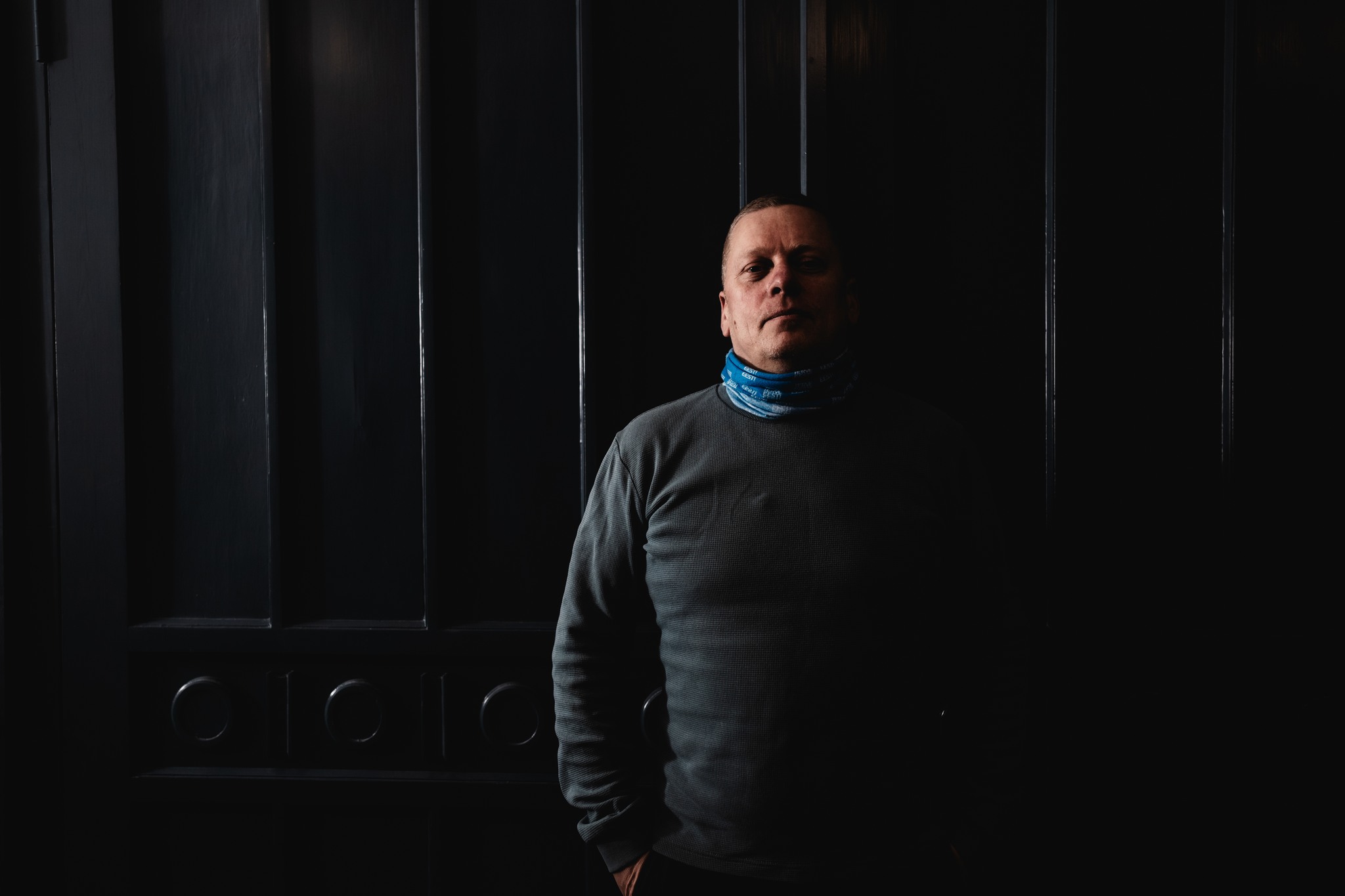
We have been trying to catch up with him for weeks. Ergo's path is still full of twists and turns. When we finally sit down in Ukuaru's office (Tintinnabularium), the man says that he now has time to relax.
"I'm the type who quickly builds a brick wall around himself, and I'm not a particularly talkative," he says. "But I came out today to make my contribution so that maybe in the future someone will be interested in what happened here and what this project meant."
With Ergo ready to share, it feels like the perfect moment to begin recording this remarkable history.
"I clearly remember standing in Kertu's (Ukuaru director Kertu Orro) office. I watched as the church stood upright on its piles. I wondered if it would fall into the hole dug for the extension or stay in place," Ergo says, gesturing towards the office and turning his gaze towards the church.
For Ergo, the journey to this heart-stopping moment began back in January 2024. “I was aware that the city of Rakvere had received money to build a concert hall. I immediately imagined that Revin could build it. There aren’t many companies that could handle such a large project.”
When Revin won the tender, the project team struggled. “A very complex project. Building the old and the new together is extremely difficult,” explains Ergo.
He says that although he likes challenges, this project was different. Upon reviewing the main project, Ergo knew from experience that this construction would stand apart from his previous ones. He anticipated two years working with one team, managing hundreds of employees, and ensuring their occupational safety.
Safety first
Safety was one of the most important keywords for Ergo on this journey. He couldn’t imagine a worker coming to work in the morning and not making it home in the evening.
Ergo draws parallels between ensuring safety during Defence League winter training and on a construction site. As an officer, he believes families must know their loved ones will come home safe.
According to Ergo, safety starts with doing the work in the right order. “First the scaffolding and then the ceiling!”
I ask how many accidents the team has had over the past 2 years. “Zero!” says Ergo. “Everyone contributed to making sure there are no accidents.”
To illustrate the importance of occupational safety, Ergo gestures to an apple on the table. He explains that you may take a bite out of an apple and glue it back together, but it will still never be the same; injuries deeply affect a person, even when they seem healed.
If proper scaffolding has been put up, the site is clean and tidy, there are railings on the stairs, and broken extension cords and ladders are not used, then, according to Ergo, accidents generally do not happen. “In such a situation, the worker can concentrate fully on the work, and he does not think about whether he will suddenly fall down somewhere.”
Safety also had to be ensured for the townspeople, not just the workers on the site. “People were also looking behind the fence, big machines were driving next to the school building, and children were all around. It creates tension, having to ensure the safety of all parties.”
But Ergo and Revin site manager Valmar Tuur also had to fight for their own well-being. The man recalls a vivid memory of when he and Valmar went to the attic under the roof to look at the structures. There were about a hundred pigeons that had found a home there. When the men opened the hatch, the winged creatures attacked, as in Hitchcock's film "The Birds". "I will always remember that image. It was CRAZY! I sometimes see those pigeons in my dreams at night," says Ergo.
There were also about a hundred pigeon bodies in the attic and half a meter of bird droppings. "At first, we thought we were going to get bird flu from here!"
However, the men managed to politely tidy up the attic, and now, according to Ergo, you can even dance there.
The project brought butterflies
Another difficult moment was digging a hole several meters deep into the surface of the future hall, while complying with the heritage conservation requirement to preserve the buttresses, or supporting columns, along the edge of the hole. The hole was needed to accommodate today's stage modules and the hydraulic hoses and pipes beneath them that raise and lower the stage and the parterre.
The hole also had to be deep enough to create a chair storage for the stage modules. "It's a very good solution so you can quickly pack the chairs under the stage and create a dance floor in the hall," says Ergo. “The hole got deep enough that I even wondered if all those fancy piles that were drilled into the ground to hold the buttresses would hold up. You weld a metal beam on Friday to support it when excavation work starts, then on Saturday and Sunday, you walk around your house wondering if the whole structure will hold up, and if on Monday, it will be the same as on Friday. At the same time, you don’t want to come here to look, because maybe something has happened. You can’t describe moments like that in words.”
But the designers made proper calculations, and everything worked as planned on paper.
At the same time, all these challenges were part of Ergo's process. “It was a thrill. I’m so old, but the project brought butterflies to my stomach. I was always thinking about how cool it would all be.”
In the first year, Revin and the team focused mainly on the extension. Ergo says the old house, or church part, felt like a lover waiting for attention.
“When the builders finally got into the concert hall, exciting things started happening there, and there was a lot of brainstorming every day,” says Ergo.
To drill the piles, a drilling machine with a 20-meter-long boom had to be brought in through the church doors, even though the doorway was smaller than the machine itself. Ergo describes it as trying to fit a large cupboard through a much smaller door: the room is four meters wide and three meters high, but the door is only 90 by 210 centimeters. You can’t lay it down or stand it up, but you still need to fit it through.
So what to do? The drilling machine was dismantled into parts, brought in, reassembled inside, and the job was done.
Reflecting on these hurdles, I ask whether Ergo ever felt the building wouldn’t be completed on time, to which Ergo answers a resounding no before I finish the question.
Building only with love!
Building only with love!
When did the site team feel that the construction site had become a more homely environment? “When we turned on the floor heating, the radiators were on the wall. When the heating started working, we felt at home. It was warm; we were wearing sweatshirts. Valmar and I sat on the stage and thought we had finally finished something great with the team. We discussed with a conductor who was visiting here in the concert hall that we were, in a sense, colleagues. He passes on the creations of great composers by conducting an orchestra, and we pass on the ideas and visions of great architects by building.”
Did the man ever shed a tear from the great tension? “While building the project, the tensions didn’t break me, but I personally thought about the project more than I should have. Sometimes, I felt so overwhelmed at night that I could hardly sleep, the stress and pressure weighing on me. I came to work in the morning and told the subcontractor that I had been thinking about this and that at night, so that he could resolve the matter. The guys understood that I don’t sleep at night. When you start a project, there is time and money, and everyone enjoys the progress of the construction. When the final stage arrives, money and time run out, and tensions arise.”
Much had to be sacrificed. Before joining the Ukuaru project, Ergo studied engineering at Tallinn University of Technology but left because he couldn’t fit more than 24 hours into his day. "I’ll probably catch up on those studies now," he thinks aloud. Despite these sacrifices, the sense of pride in their accomplishment remained strong.
What is Ergo most proud of when it comes to building the music hall? He answers without hesitation.
“Of the team we did this with! I would like to single out Valmar in particular. We supported each other’s strengths and weaknesses. We didn’t need to talk about them; we didn’t need to use words. We saw them on the run, and we could always rely on each other. Secondly, I commend the project manager Andre Liiva, who worked hard on the small details. All in all, I feel very proud of Revin Grupp as a company, from the assistant worker to the top. Everyone who worked on this project gave 100% of themselves to ensure that the construction was completed.”
The team chose to involve as many Lääne-Virumaa companies as possible in the process, bringing in specialists for acoustic panels, sheet metal, concrete, electrical work, and facade tiles. Everyone made significant contributions to completing this project. This collaborative approach shaped the on-site atmosphere.
For Ergo, it was important that the work was done with a good feeling and that any tensions that surfaced were resolved outside the site – whoever comes to push even the smallest stone into place or holds a brush in their hands must do so with good energy. “We wanted to build with positive emotion, because this is not just any house. This is a CONCERT house,” emphasizes Ergo. “The conflicts were left in the office space.”
When the Arvo Pärt Concert Hall Ukuaru was completed, Ergo looked at the building with pride from the far end of the parking lot. “I thought, damn… what a great thing! I feel that Rakvere is worthy of this house. Rakvere is a great place! Revin’s team gave the body—now you give the soul, the warmth!” With emotion running high, Ergo reflected on the project's meaning.
I ask what invisible quality he gave the concert hall, and Ergo is suddenly lost for words. “I can’t say. I get too emotional…” he says quietly. "I'd rather keep that to myself."